
B2B distributors need account-level pricing, order complexity management, and real ERP integration. Here is what to look for and how to test it before you commit.
By Lucinda Miller | November 3, 2026
See why top ecommerce brands use Miva’s no-code platform to run
multiple stores, manage massive catalogs, and grow their revenue.
The first sign is usually the workarounds. A distributor's operations team starts maintaining a separate spreadsheet to track which customers get which pricing, because the platform cannot handle account-level contracts. Then a second spreadsheet appears for split-shipment rules. Then a third for minimum order quantities by product category. By the time the platform has been live for 18 months, the digital channel requires more manual intervention than the phone order process it was supposed to replace.
This is how B2B distributors end up with ecommerce platforms that technically work but operationally fail. The platform was built for retail. The distributor's business runs on contracts, account relationships, and order complexity that retail-first platforms were never designed to accommodate. The gap between what distributors need and what most platforms deliver is not a configuration problem. It is an architecture problem.
Understanding that gap before selecting a platform is the only way to avoid building it for the second time in three years. Distributors who have gone through one failed implementation know exactly what this costs: sunk licensing fees, a demoralized operations team, buyers who tried the digital channel once and went back to calling. A second failure at a different vendor does not get easier to explain internally.
This article maps the four functional requirements that separate a platform built for B2B distribution from one that was adapted for it, explains what each one looks like when it works and when it does not, and gives you a structured evaluation test you can run before signing anything.
|
A price list is not a pricing strategy. B2B distributors run on negotiated account contracts. A platform that cannot enforce those contracts at the order level is not a B2B platform. |
Most distributor ecommerce failures trace back to one of four functional gaps. Platforms that look capable during a sales demo often surface these gaps six months after go-live, when the volume of manual exceptions starts outpacing the capacity of the operations team to handle them. The framework below maps the four gaps, what each covers, the metric that reveals whether it is working, and the failure mode that appears when it is not.
|
Component |
What It Covers |
Key Metric |
Common Failure Mode |
|
Account-Based Pricing Architecture |
Contract pricing, volume tiers, customer group discounts, negotiated rates by SKU |
Price accuracy rate: order vs. contract |
Platform applies list price instead of account contract at checkout |
|
Order Complexity Management |
Split shipments, backorders, partial fulfillment, minimum order quantities, lead time display |
Order error rate, fulfillment exception rate |
System cannot split one order across multiple ship dates or warehouse locations |
|
Buyer Role and Approval Workflows |
Multi-user accounts, purchase approval thresholds, budget controls, order history by buyer |
Approval cycle time, unauthorized order rate |
All buyers on an account share identical permissions with no approval routing |
|
ERP and Operational Data Integration |
Real-time inventory sync, order transmission, AR balance display, credit limit enforcement |
Integration error rate, inventory accuracy at order time |
Inventory displayed in the platform does not match ERP; orders sync on a delay |
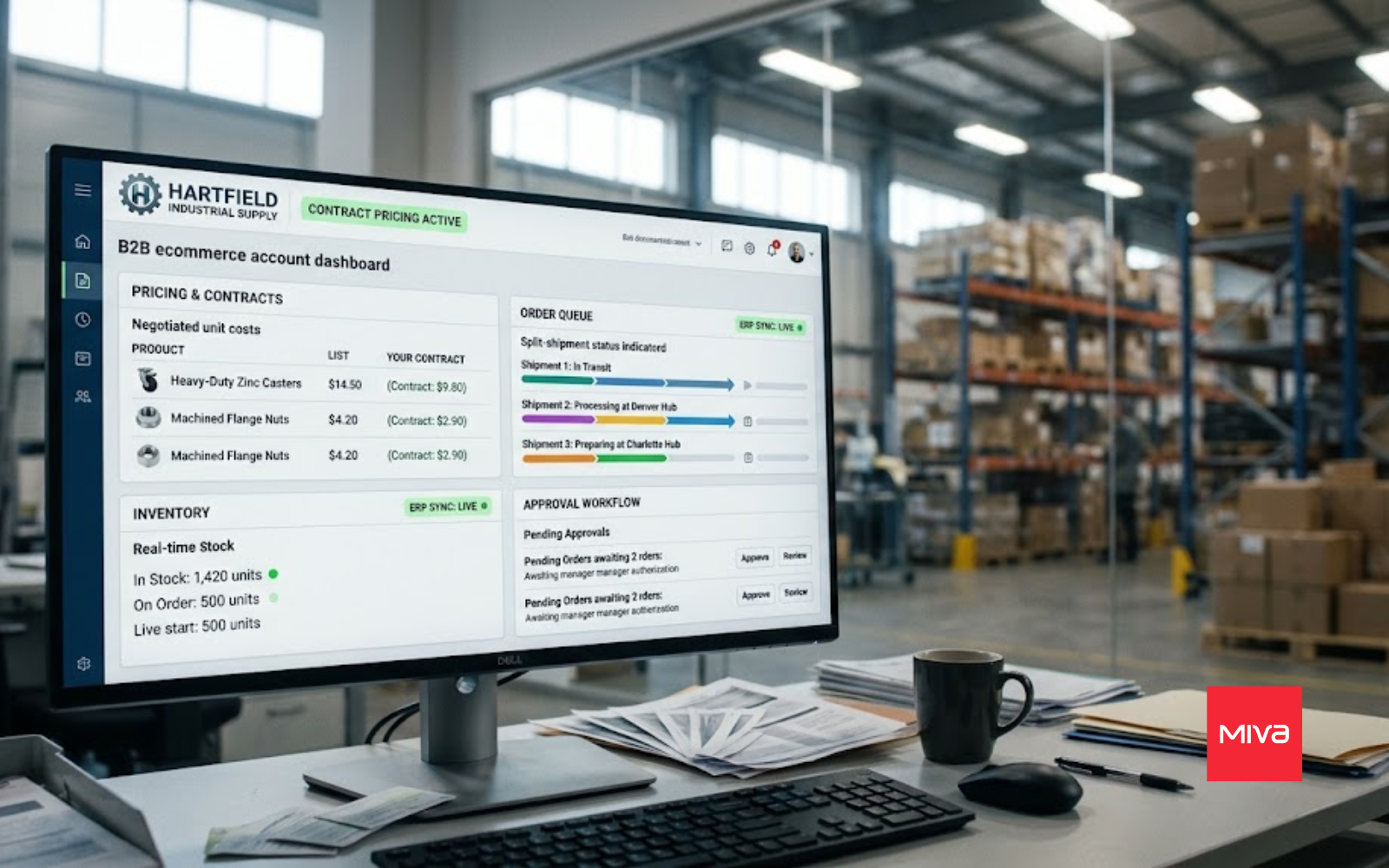
Pricing is the most common failure point for distributors moving to ecommerce. A distributor with 400 active accounts may have 400 different pricing structures. Some customers have negotiated rates on specific SKU categories. Others have volume-based discounts that activate at order thresholds. Still others are on fixed contract pricing that does not change regardless of list price adjustments.
A retail-oriented platform handles one pricing model well: list price, with a discount code applied at checkout. That model fails immediately in a distribution environment. When a contract customer places an order and sees list price at checkout, the order either gets abandoned or the operations team has to intervene manually to correct the invoice. The downstream cost of that intervention is rarely visible in platform analytics, but it accumulates fast. Distributors who want to get the pricing architecture right before replatforming will find more detail in this overview of B2B ecommerce pricing strategy.
The correct architecture enforces pricing at the account level before the buyer reaches checkout. It reads from the customer's account record, applies the correct pricing tier for each SKU, and presents an accurate order total without requiring manual correction. This is not a discount engine. It is a contract enforcement system. The distinction matters because discount engines are designed to reduce price at the point of sale. Contract enforcement systems are designed to present the correct price as the starting point.
The practical difference shows up in catalog management. A discount engine approach requires someone to maintain a master price list and then layer discounts on top of it for each account. A contract pricing system stores the account's rates directly and serves them at login. The first approach creates an ongoing maintenance burden. The second does not.
Distributors evaluating platforms should test this specifically: log in as three different test accounts with different pricing contracts and verify that each sees the correct price on the same SKU. If any account sees list price, the B2B ecommerce platform is not built for distribution.
Distributor orders are structurally different from retail orders. A single purchase order from a buyer might include items available for immediate shipment, items on backorder with a three-week lead time, and items that ship directly from a manufacturer. The platform needs to handle all three within the same order, communicate accurate fulfillment timelines to the buyer, and route each line item correctly without operations team intervention.
Retail platforms process one shipment per order. That assumption breaks in distribution. When a platform cannot split an order across multiple fulfillment paths, distributors are forced to either ask buyers to place separate orders, which they will not do consistently, or process the split manually downstream, which consumes operations capacity and creates error risk at scale.
Minimum order quantities add another layer of complexity. A distributor may enforce MOQ at the product level, the category level, or the account level. Some accounts are exempt from MOQ requirements based on their contract terms. A platform that cannot enforce these rules automatically pushes enforcement to the customer service team, which defeats the purpose of a self-service digital channel. When the customer service team is spending time on MOQ enforcement, they are not spending time on high-value account management.
Backorder visibility is one of the highest-value features for distributor buyers. A buyer who can see that an item is out of stock but available in 11 days can make an informed decision about whether to wait or source elsewhere. That transparency builds trust in the digital channel and reduces inquiry volume hitting the inside sales team. For distributors considering a platform change, the B2B ecommerce replatforming guide covers the order complexity evaluation process in detail.
Most B2B accounts have multiple buyers. A regional distributor with 200 accounts might have three to eight individual buyers per account, each with different purchasing authority. A junior buyer might be authorized to place orders up to $2,500 without approval. A senior buyer might have an $8,000 threshold. Orders above those thresholds route to an account manager before submission.
This is standard procurement practice for any organization of meaningful size. It is also something that retail ecommerce platforms do not support. Retail platforms have one customer record per email address. That model cannot accommodate multi-user accounts with role-based purchasing authority. For distributors selling into manufacturing and industrial accounts, the manufacturer direct commerce guide covers how these buyer relationships work across the supply chain.
A platform built for distribution handles this by separating the account from the individual buyers within it. Each buyer logs in with their own credentials and sees the account's pricing, order history, and product catalog. Their individual purchasing limits are attached to their buyer profile, not the account as a whole. When an order exceeds their threshold, the platform routes it to the designated approver rather than processing it immediately.
The approver receives a notification, reviews the order, and either approves or modifies it before it submits to the distributor. This mirrors the approval workflow the buyer's procurement team already uses internally, which is exactly why buyers adopt it. A digital channel that matches the buyer's existing procurement process has a much higher adoption rate than one that asks buyers to change how they work.
The absence of approval workflows is often what drives distributors to maintain parallel processes. Buyers who cannot complete orders through the digital channel fall back to calling or emailing, which means the platform adds process instead of replacing it. The omnichannel commerce framework explains how buyer channel preference connects to operational efficiency for distributors managing multiple touchpoints.
A B2B distributor's ecommerce platform is not a standalone system. It is an interface layer over the operational data that lives in the ERP, the warehouse management system, and the AR system. The value of the digital channel depends entirely on the accuracy of the data flowing from those systems into the platform.
Inventory accuracy is the most immediate issue. If the platform shows 48 units available and the ERP shows 12, the buyer places an order the warehouse cannot fill. That creates an exception requiring a phone call, a revised order, and a delay. After this happens a few times, buyers stop trusting the platform and call instead. The digital channel loses its primary value proposition: reducing inbound call volume.
Credit limit visibility matters almost as much. A buyer approaching their account's credit limit needs to know before completing an order, not after submitting it and waiting for a rejection. A platform that displays real-time AR balance and available credit turns that friction point into a buyer-facing feature. Details on ERP and system integration options are worth reviewing early in any platform evaluation, before the technical team gets involved.
The integration architecture also determines how quickly orders flow from the platform to the warehouse. A platform that syncs orders in batches every two hours creates a gap between when the buyer thinks the order was placed and when the warehouse starts picking it. For distributors competing on fulfillment speed, that gap is a direct competitive liability. Buyers who need same-day processing cannot rely on a system with a multi-hour sync window.
ERP integration testing should be part of any platform evaluation. Specifically: how does the platform handle an order placed on a SKU that goes to zero inventory during the time between the buyer adding it to the cart and completing checkout? A platform without a real-time inventory reservation mechanism will oversell that SKU and create a fulfillment exception. Test this before you commit, not after. The scenario is common in high-velocity distribution environments and it exposes whether the integration is truly real-time or simply fast batch.
|
Merchant Example: Industrial Parts Distributor An industrial parts distributor with 16,000 active SKUs and 340 account customers migrated their digital channel to a platform built for B2B distribution. Before the migration, the operations team spent an average of 22 minutes per online order resolving pricing discrepancies, split-shipment exceptions, and inventory errors. After the migration, that number dropped to under four minutes per order. Online order volume increased 38% in the first six months as buyers who had previously called or emailed shifted to self-service ordering. The operations team reallocated the recovered capacity to proactive account management work instead of exception handling. Customer satisfaction scores for the digital channel reached 4.3 out of 5.0 within the first year. Results are illustrative of outcomes achievable with this architecture. Actual results vary by merchant. |
Three tests reveal more about a platform's actual B2B capability than any demo or feature list. Run all three before signing a contract.
Create three test accounts with different pricing contracts. Log in as each. Add the same SKU to the cart and proceed to checkout. Verify that each account sees its correct contracted price, not list price. If any account sees list price, the platform's pricing architecture is not built for distribution. This test takes less than 30 minutes and eliminates the most common failure mode before it reaches production.
Place a test order that includes an in-stock item, a backordered item, and an item that ships from a secondary location. Verify that the platform handles the split without requiring manual intervention from your operations team. Ask specifically how the platform communicates different fulfillment timelines to the buyer within a single order confirmation. If the answer involves manual processes, that manual intervention will happen on every equivalent order in production.
Place a test order and measure how long it takes to appear in the ERP. Then exhaust the available inventory of a SKU through a test order. Place a second order for that same SKU immediately after. Verify that the platform blocks or flags the second order in real time rather than allowing an oversell. If the platform cannot demonstrate this in a test environment, assume it cannot handle it in production.
If a platform fails any of these tests during evaluation, it will fail them in production at higher volume and with real customer relationships on the line. Schedule a platform evaluation to run these tests in a structured environment before making a decision.
Distributors who want to review the full capability set before running evaluation tests can start with the platform features overview to identify which capabilities to prioritize in the assessment.
|
What is the difference between a B2B ecommerce platform and a regular ecommerce platform? |
A B2B platform supports account-level pricing, multi-buyer accounts with approval workflows, order complexity like split shipments and backorders, and deep ERP integration. A retail platform is built for individual consumers with single prices and simple order structures. Applying a retail platform to a distribution business requires workarounds that consume operational resources and undermine the value of the digital channel. |
|
How do I move my distributor pricing contracts to an ecommerce platform? |
The migration process maps each account's negotiated rates to the corresponding customer group or account record in the platform. Most platforms with real B2B pricing support import via CSV or direct API connection to the ERP where contract data already lives. Before migrating, audit your pricing data to confirm that each account's current rates are documented and accessible in a structured format. |
|
Can a B2B distributor ecommerce platform connect to my ERP system? |
Yes, but integration quality varies significantly by platform. The critical questions are: how often does inventory sync (real-time vs. batch), how are order conflicts handled when inventory changes between add-to-cart and checkout, and can the platform display AR balance and credit limits pulled live from the ERP. Batch integrations create operational gaps. Real-time integrations eliminate them. |
|
What should distributor buyers be able to do on a self-service portal? |
At minimum: view account-specific pricing, browse the full catalog with accurate stock and lead time information, place orders up to their approval threshold, submit orders for approval above that threshold, view order history by buyer and by account, and access invoices and payment history. Buyers who cannot complete standard procurement tasks without calling will not use the platform. |
|
How long does it take to implement a B2B ecommerce platform for a distributor? |
Implementation timelines depend on catalog size, the number of ERP integrations required, and pricing complexity. A distributor with 5,000 to 15,000 SKUs and a single ERP integration typically sees a three to six month implementation. Larger catalogs, multiple ERP systems, or heavily customized approval workflows extend that timeline. Plan for a parallel operation period where both the legacy process and the new platform run simultaneously to catch configuration issues before full cutover. |
No worries, download the PDF version now and enjoy your reading later...
Download PDF Lucinda Miller