In automotive ecommerce, discovery is everything.
Customers don’t browse auto parts for fun: They’re on a mission. When they can’t quickly confirm fitment or find the exact part they need, they leave. No amount of pricing strategy or promotion can save a sale if search fails at the starting line.
That’s why product discovery is the biggest conversion lever in automotive ecommerce. And it’s also where many stores struggle the most.
Let’s break down why automotive search fails, how fitment strategies differ, and what modern merchants can do to reduce friction and convert more shoppers.
Why “No Results” Searches Happen in Automotive Ecommerce
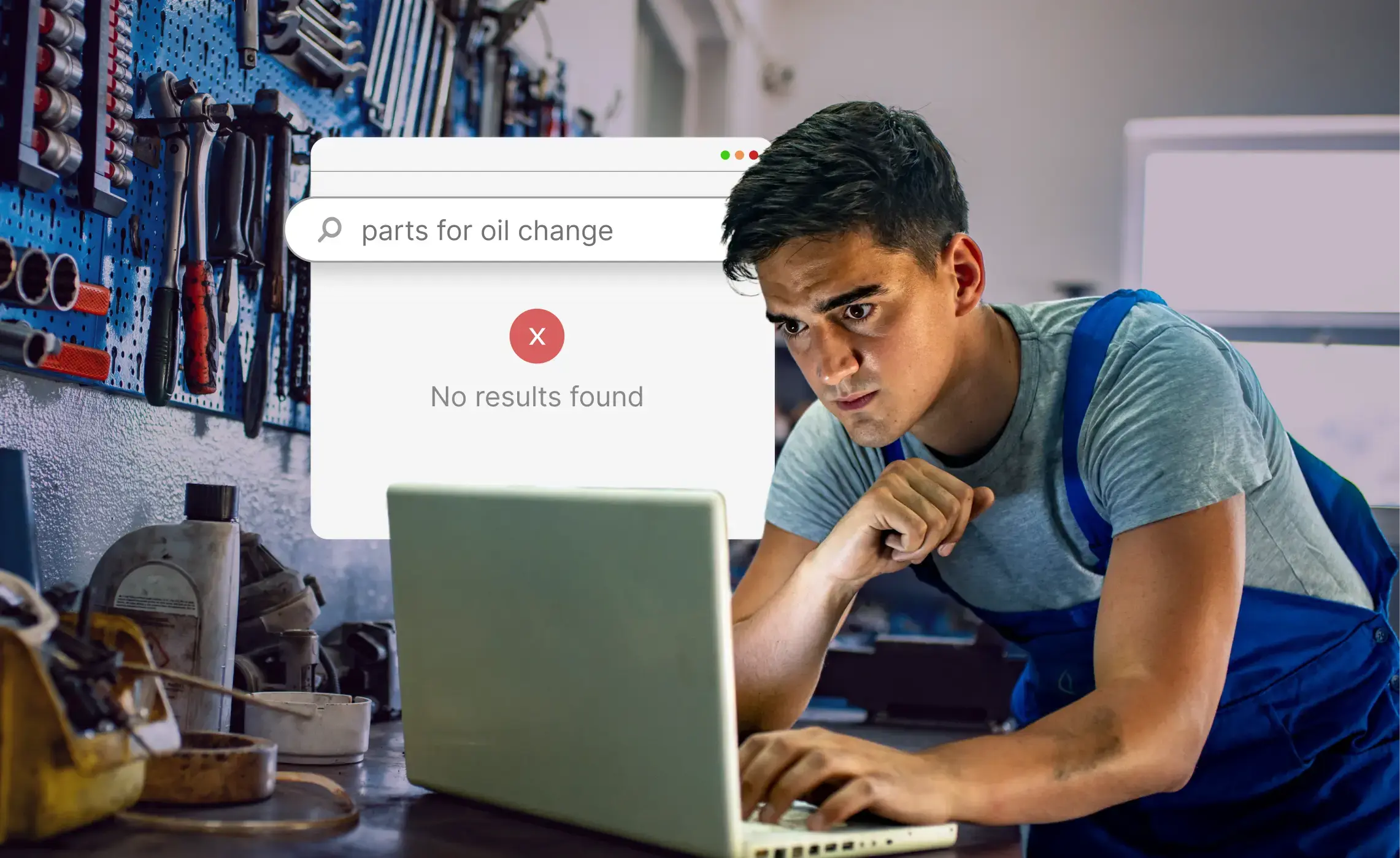
“No results found” is a dead end that kills conversion opportunities.
In automotive ecommerce, this happens frequently because:
- Customers search using partial part numbers
- They use colloquial or industry-specific language
- They don’t know the exact SKU
- Fitment data isn’t connected cleanly to search
- Filters are too rigid or incomplete
A shopper might search for:
A traditional keyword-based search might not recognize that query, even if the correct product exists.
The result: friction, doubt, and abandonment.
VIN Lookup vs Attribute-Based Fitment
Fitment is the backbone of automotive ecommerce, but not all fitment approaches solve the same problems.
VIN Lookup: High Precision, High Friction
VIN lookup offers accuracy, but it also creates barriers:
- Requires customers to locate their VIN
- Adds steps before browsing can begin
- Doesn’t help shoppers who are researching or comparing options
VIN tools are valuable, but not always sufficient on their own.
Attribute-Based Fitment: Flexible and Discoverable
Attribute-based fitment (year/make/model/engine/trim) allows shoppers to:
- Explore compatible products naturally
- Filter results incrementally
- Browse alternatives and upgrades
Best practice:
Use attribute-based fitment as the primary discovery layer, with VIN lookup as a validation or refinement tool, not a gatekeeper.
Keyword Search vs AI-Powered Search
Traditional ecommerce search assumes customers know exactly what to type. Automotive shoppers rarely do.
Where Keyword Search Falls Short
- Misses partial or misspelled queries
- Fails to connect intent (“replacement,” “upgrade,” “heavy duty”)
- Can’t interpret compatibility context
- Returns empty or irrelevant results
How AI-Powered Search Changes the Game
AI-powered search—like Vexture®—is built to understand intent, not just exact matches.
Instead of asking:
AI search asks:
With AI search, automotive merchants can:
- Interpret natural language and fuzzy queries
- Recognize synonyms and industry terminology
- Surface compatible products, even when terms don’t align perfectly
- Reduce “no results” outcomes dramatically
Result: faster discovery, fewer dead ends, higher confidence.
Faceted Navigation at Automotive Scale
Filters are essential, but only when they scale properly.
Automotive catalogs often include:
- Thousands (or tens of thousands) of SKUs
- Dozens of attributes per product
- Complex fitment relationships
Poorly designed filters create more friction instead of less.
What Works
- Faceted navigation that adapts dynamically based on selection
- Fitment-aware filters that only show valid options
- Attribute groupings that match how customers think (not internal data models)
Miva’s faceted navigation is designed to handle large, attribute-rich catalogs without slowing performance, so customers can refine results confidently without overwhelming the system.
Merchandising Strategies for Compatible Products
Discovery doesn’t stop once the right product is found.
Automotive shoppers often need:
- Complementary parts
- Installation accessories
- Upgraded or premium alternatives
- Maintenance add-ons
Manual “related products” rules don’t scale in automotive. Catalogs change too often, and fitment relationships are too complex.
Smarter Merchandising Approaches
With AI-powered merchandising, merchants can:
- Automatically suggest compatible accessories
- Promote higher-margin alternatives
- Surface frequently purchased combinations
- Adapt recommendations based on fitment, cart contents, and context
Vexture® supports this by using intent and compatibility signals, reducing manual setup while keeping recommendations relevant.
Why Speed and Accuracy Matter More in Automotive
Automotive ecommerce isn’t forgiving.
If search results are slow, filters lag, or pages hesitate under load, confidence drops immediately. Customers assume:
- The part might not fit
- The site may not be reliable
- Support will be difficult if something goes wrong
Platforms built to support large fitment databases and high-SKU performance ensure that discovery remains fast and accurate, even during traffic spikes or seasonal demand.
Speed isn’t just a technical metric here; it’s part of trust.
Reducing Friction Is the Conversion Strategy
Automotive shoppers don’t need flashy experiences. They need:
- Clear fitment
- Fast answers
- Confidence in compatibility
- Minimal steps to checkout
Optimizing product discovery means:
- Combining fitment logic with flexible filtering
- Replacing rigid keyword search with intent-aware AI
- Using merchandising to guide, not distract, buyers
- Supporting scale without slowing down
In automotive ecommerce, search failure is conversion failure.
When customers can’t find the right part (or aren’t confident it fits), they leave. But when discovery is fast, intuitive, and accurate, conversion becomes the natural outcome.
By investing in smarter fitment strategies, scalable filtering, and AI-powered search and merchandising, automotive brands can remove friction at the most critical moment of the buying journey.
And when discovery works, everything else performs better.

 Miva
Miva