
By Lucinda Miller | November 17, 2026
See why top ecommerce brands use Miva’s no-code platform to run
multiple stores, manage massive catalogs, and grow their revenue.
The problem became visible in the return data. A regional auto parts retailer with 340,000 active SKUs was running a 19% return rate on online orders. The operations team assumed it was a carrier problem. They audited shipping performance. Carriers were fine. The returns were fitment returns: customers receiving parts that did not fit their vehicle because the website's year-make-model lookup had directed them to the wrong application.
The fitment database had not been updated in 14 months. The platform's year-make-model lookup was a third-party plugin reading from a static export rather than a live fitment data feed. When new model years arrived and supersession chains changed, the plugin continued serving outdated data. Every order placed on a stale fitment match was a potential return, a potential one-star review, and a customer who might not come back.
After diagnosing the root cause, the retailer had two options: attempt to maintain a live fitment data pipeline into a plugin that was never designed to receive one, or move to a platform where fitment data architecture was part of the core product. They chose the second path. Within six months of the migration, their fitment return rate had dropped from 19% to 4%.
This is not a unique story. It plays out consistently at auto parts retailers who built their ecommerce presence on a general-purpose retail platform and added fitment capability as a plugin after launch. The fitment problem is not solved by adding tools on top of a retail platform. It is solved by building fitment data architecture into the platform from the beginning.
A year-make-model lookup is not a feature add-on. For an auto parts retailer, it is the structural foundation the entire catalog is built on. A platform that treats YMM as a plugin cannot serve this business reliably.
Auto parts ecommerce has four functional requirements that do not exist in general retail. Each one requires architectural support, not a workaround. The framework below maps what each requirement covers, the metric that reveals whether it is working, and the failure mode that appears when it is not.
|
Component |
What It Covers |
Key Metric |
Common Failure Mode |
|
Fitment Data Architecture |
Year-make-model lookup, fitment database currency, application guide accuracy, supersession chain management |
Fitment return rate, YMM lookup accuracy rate |
Fitment database populated from a static export; not updated when vehicle data or supersessions change |
|
Part Number and Cross-Reference Management |
OEM part numbers, aftermarket equivalents, superseded numbers, interchange lookups, brand cross-referencing |
Cross-reference accuracy rate, part number search hit rate |
Platform stores one number per SKU; buyers who search by OEM or superseded number find nothing |
|
Catalog Search and Filter Performance |
Attribute-driven filtering, part number search, application lookup, faceted navigation for large catalogs |
Search-to-cart conversion rate, zero-results search rate |
Search returns too many irrelevant results on large catalogs; filter options do not expose the attributes buyers use |
|
Inventory and Supplier Integration |
Multi-warehouse inventory, dropship logic, supplier catalog feeds, real-time availability from distributor APIs |
Order fill rate, dropship exception rate, inventory accuracy at order time |
Inventory shown as available when supplier stock is exhausted; dropship orders fail because availability was not checked at checkout |
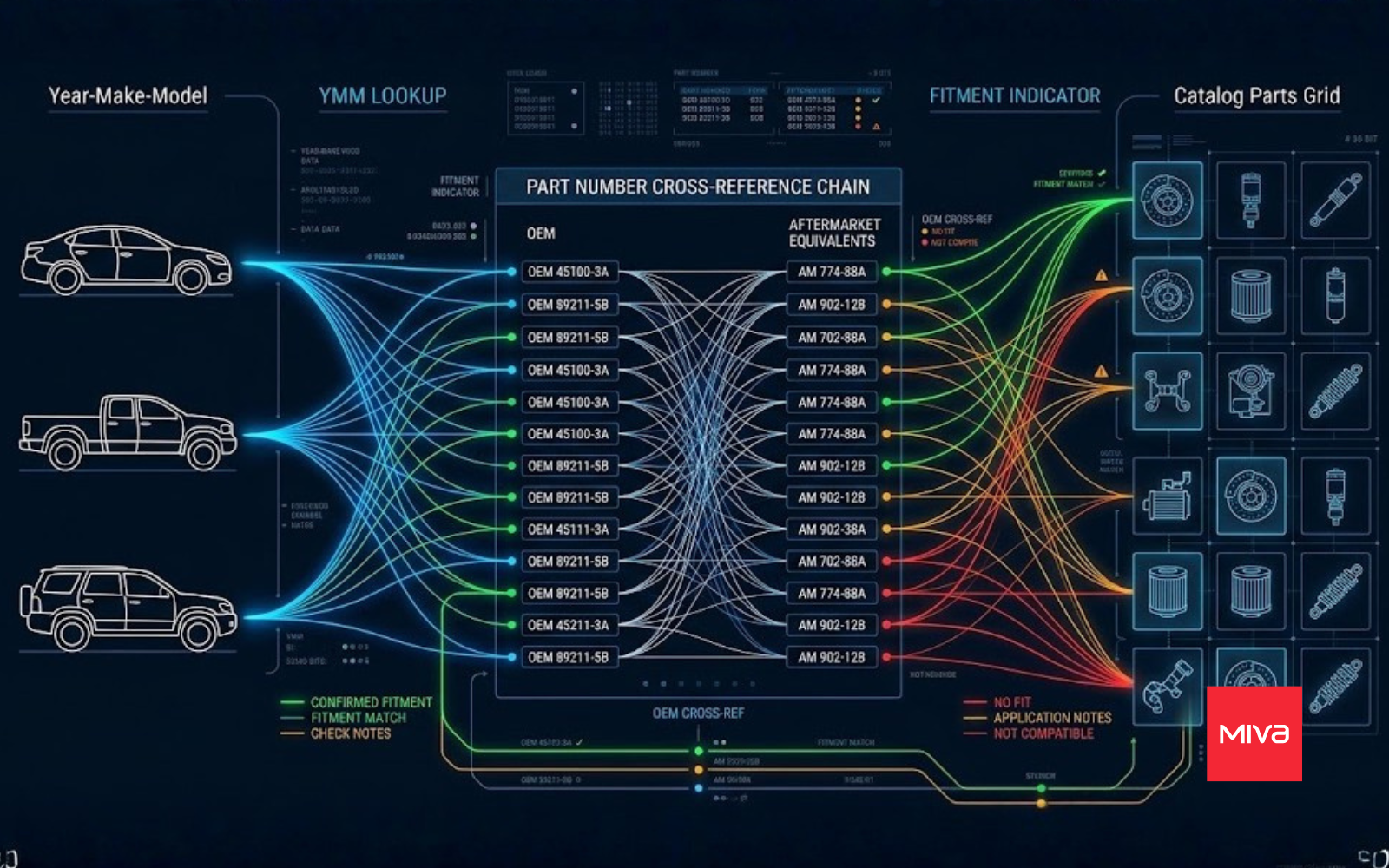
Fitment data is the foundation of auto parts ecommerce. A buyer searching for brake pads does not want to see all brake pads. They want to see brake pads that fit their 2019 Ford F-150 with a 5.0L engine and four-wheel drive. The year-make-model lookup filters the catalog to the buyer's specific vehicle application. If that filter is inaccurate, every result it returns is a potential wrong-part order.
The accuracy challenge is continuous. Vehicle manufacturers add new model years every year. Parts are superseded when manufacturers update specifications or part numbers. Aftermarket suppliers add new applications to their fitment coverage. A fitment database that is accurate today will begin to degrade immediately unless it is connected to a live data source that reflects these changes as they happen.
Platforms that support fitment data natively maintain a connection to industry-standard vehicle data sources and allow retailers to layer their own fitment notes on top. Platforms that treat fitment as a plugin layer it onto a product structure that was designed for simple attribute storage. The difference shows up in the accuracy of the lookup and in the speed of catalog updates when vehicle data changes. Getting platform features evaluated specifically for fitment data handling should be one of the first steps in any platform assessment for an auto parts retailer.
Application guides add another layer of complexity. A part may fit 47 different year-make-model-submodel combinations. Some of those applications require installation notes. Some have position-specific fitment (front left, rear right). Some have compatibility notes with specific trim levels or engine configurations. The platform needs to store and serve all of this at the SKU level without creating catalog management overhead that consumes the data team's capacity.
Auto parts buyers search by part number as often as they search by description. A professional installer searching for a specific OEM part number expects to find the aftermarket equivalent immediately. A buyer replacing a part they have in hand searches by the number printed on the old part, which may be a superseded number no longer in active use. A fleet buyer purchasing for multiple vehicles may have a list of part numbers from a maintenance system that does not match any current catalog number.
A general retail platform stores one primary identifier per SKU. That model fails for auto parts, where a single product may have a manufacturer part number, an OEM cross-reference number, one or more superseded part numbers, and cross-references to equivalent parts from competing brands. A buyer who searches by any of these numbers needs to land on the correct product. A platform that only indexes the primary part number returns a zero-result page for every other valid number.
The zero-results problem is directly measurable. A catalog with strong cross-reference coverage will show a zero-results search rate below 5% for part number searches. A catalog with only primary numbers indexed will show zero-results rates of 20% or higher on part number queries. Those misses represent buyers who searched, found nothing, and left. They affect ecommerce conversion rate as directly as any checkout friction point, and they are harder to diagnose without looking at the right data.
Supersession chain management requires ongoing maintenance. When a manufacturer supersedes a part number, the old number should redirect to the current active SKU rather than returning a dead page. Retailers who manage this manually fall behind within weeks of a major supplier catalog update. Retailers whose platform supports automated supersession handling maintain accurate cross-references without the manual overhead.
Auto parts catalogs are large. A mid-size retailer may carry 200,000 to 500,000 SKUs across dozens of part categories, hundreds of brands, and millions of vehicle applications. A buyer navigating that catalog without robust search and filtering will not find what they need. The search architecture has to handle three distinct buyer behaviors simultaneously: application-based browsing (find parts for my vehicle), part number lookup (find this specific number), and attribute-based filtering (find all 6-quart oil filters for a 5.0L engine).
Most retail search implementations handle keyword search adequately. They do not handle application-based browsing well without specific fitment filtering capability built into the search layer. A buyer who selects a vehicle from the YMM lookup and then searches within that vehicle's application set needs the search results to stay filtered to their vehicle throughout the session, not reset to the full catalog on every query. Site speed and search response time compound the problem: a search that takes three seconds to return results on a catalog this size loses buyers before the results load.
Faceted navigation is the other critical element. A buyer filtering brake rotors needs to be able to narrow by diameter, bolt pattern, vented or solid, slotted or drilled, and brand simultaneously. The filter attribute set for brake rotors is different from the filter attribute set for motor oil, which is different from the filter attribute set for wheels. A platform that handles faceted navigation generically, with the same attribute structure across all categories, will surface the wrong filters for most product types in an auto parts catalog.
Category-specific filter configuration requires the platform to support custom attribute sets per product category and to expose those attributes as filterable facets in search results. This is a catalog architecture decision, not a search optimization decision. Retailers who configure it correctly see 30 to 50% higher search-to-cart conversion rates compared to retailers running generic filtering on the same catalog.
Most auto parts retailers do not warehouse everything they sell. They stock their highest-velocity items and fulfill the long tail through supplier dropship programs and distributor relationships. A retailer with 340,000 SKUs in the catalog may warehouse 40,000 and dropship the rest from two or three regional distributors. The ecommerce platform needs to know which inventory is on hand, which is available for dropship, and what the realistic fulfillment timeline is for each path, all at the moment the buyer is considering an order.
Real-time inventory availability from supplier APIs is the standard for retailers running dropship programs at scale. A platform that checks inventory on order placement rather than at add-to-cart will show products as available that have been exhausted at the supplier level. The buyer completes checkout, receives an order confirmation, and then receives an out-of-stock notification 24 hours later. That experience has the same effect as a fitment return: it erodes trust and reduces the likelihood of a repeat purchase. ERP and supplier integrations designed for auto parts distribution handle this by querying availability in real time before the buyer reaches checkout.
Multi-warehouse inventory management adds another dimension. A retailer with three regional warehouses wants to route each order to the warehouse closest to the buyer to minimize shipping time and cost. The platform needs to know which warehouse has the inventory, calculate the optimal fulfillment path, and present the buyer with accurate lead times based on that calculation. Retailers whose platforms cannot route orders by warehouse proximity pay unnecessary shipping costs and lose on delivery speed against competitors who can.
Auto parts is also a category with above-average fraud exposure. High-value orders, frequent use of prepaid and virtual cards, and common patterns around high-demand parts create fraud vectors that auto parts retailers encounter more than most. The ecommerce fraud prevention framework covers how to build detection logic that catches fraud patterns specific to this category without generating false positives that block legitimate high-value orders.
Merchant Example: Regional Auto Parts Retailer
A regional auto parts retailer with 290,000 active SKUs and a dealer network of 180 professional installer accounts migrated from a general retail platform to one with native fitment data architecture and part number cross-reference support. Before the migration, their fitment return rate was running at 17% on consumer orders, and dealer orders were processed manually because the platform had no B2B account structure.
After the migration, the fitment return rate dropped to 3.8% within the first full quarter. Dealer accounts were moved to a self-service portal with account-based pricing, reducing dealer order processing time from an average of 18 minutes by phone to 4 minutes online. Online revenue from dealer accounts grew 44% in the first year as accounts that had been ordering by phone shifted to self-service.
Results are illustrative of outcomes achievable with this architecture. Actual results vary by merchant.
Many auto parts retailers serve two distinct customer segments simultaneously: consumer buyers purchasing parts for DIY repairs and professional installers purchasing parts for their shop inventory or specific repair jobs. These two segments have different pricing, different purchasing behavior, different order volumes, and different account needs.
Professional installer accounts need trade pricing, the ability to purchase on account with net terms, order history by vehicle or job, and fast reorder capability for parts they buy regularly. Shops that cannot get trade pricing through the digital channel will call instead, which means the retailer's inside sales team is processing phone orders that should be self-service. The B2B ecommerce framework covers how account-based pricing and dealer portal architecture applies to the professional installer channel in auto parts retail.
For retailers operating a parts distribution business alongside retail, the B2B distributor ecommerce guide covers the account complexity, approval workflows, and ERP integration requirements that come with serving wholesale accounts at volume.
Auto parts platform evaluations require hands-on testing rather than demo walkthroughs. A vendor demo shows the platform at its best on prepared data. A hands-on test with your own catalog, your own supplier integrations, and your own fitment data shows whether the platform can actually handle your business.
Three things to test specifically: load a sample of your most complex fitment data and verify that the YMM lookup returns accurate results across multiple vehicle applications; import a product record with five distinct part number identifiers and confirm that searching by each number returns the correct SKU; and simulate a dropship order on a product that requires a live supplier availability check and verify that the platform queries the supplier before accepting the order.
Retailers who want to run a structured evaluation against their specific catalog requirements can schedule a platform assessment before committing to a migration timeline.
|
What is the best ecommerce platform for auto parts dealers? |
The best ecommerce platform for auto parts dealers is one that supports native fitment data architecture with live year-make-model lookup, part number cross-referencing including OEM and superseded numbers, category-specific faceted search and filtering, real-time supplier inventory integration for dropship programs, and B2B account structures for professional installer accounts. General retail platforms require workarounds for all of these that become expensive to maintain at catalog scale. |
|
How does year-make-model lookup work in auto parts ecommerce? |
A year-make-model lookup filters the product catalog to parts that are confirmed to fit the buyer's specific vehicle. The buyer selects vehicle year, make, model, and often submodel or engine configuration. The platform reads this selection against a fitment database that maps parts to vehicle applications and returns only parts confirmed to fit. The accuracy of the lookup depends entirely on how current the fitment database is and whether it handles supersessions and application updates in real time. |
|
How do auto parts retailers handle part number cross-referencing on ecommerce platforms? |
Part number cross-referencing requires the platform to index multiple identifiers per SKU: the primary catalog number, OEM numbers, aftermarket equivalents, superseded numbers, and competitor cross-references. Buyers who search by any of these numbers should land on the correct product. Platforms that only index the primary part number return zero results for all other valid identifiers, which directly reduces search-to-cart conversion on part number queries. |
|
How should auto parts retailers handle dropship inventory in ecommerce? |
Dropship inventory should be surfaced to buyers based on real-time availability from the supplier, not a cached availability snapshot. The platform should query the supplier's inventory API when the buyer views a product or adds it to cart, confirm availability before checkout completes, and route the order to the correct dropship supplier at the time of fulfillment. Platforms that check availability only at order placement create a window during which buyers can order products that are no longer in stock. |
|
Do auto parts ecommerce platforms support professional installer accounts? |
Yes, platforms built for auto parts retail support professional installer and shop accounts with trade pricing, net terms, purchase order references, and order history organized by vehicle or job. The key requirement is account-type-based pricing: installer accounts log in and see trade pricing automatically, without needing to apply a discount code. Platforms that implement trade pricing via coupon codes or manual override create friction that discourages installer adoption of the digital channel. |
No worries, download the PDF version now and enjoy your reading later...
Download PDF Lucinda Miller